
Fish oil is a valuable source of Omega-3 fatty acids, particularly EPA (Eicosapentaenoic Acid) and DHA (Docosahexaenoic Acid). However, crude fish oil contains more than just Omega-3 fatty acids. It can contain free fatty acids, moisture, impurities, cholesterol and other components that need to be controlled during manufacturing.
This is where advanced purification technologies become important.
Molecular distillation is an important technology used in fish oil processing and Omega-3 concentration. It allows manufacturers to separate components based on their volatility under controlled conditions while operating at relatively low temperatures and reduced pressure.
For manufacturers supplying fish oil to the nutraceutical, pharmaceutical and functional food industries, molecular distillation can be an important part of producing purified and concentrated Omega-3 ingredients.
What Is Molecular Distillation?
Molecular distillation is a specialised separation process that operates under high vacuum and controlled temperature conditions.
Unlike conventional distillation, molecular distillation is designed for materials that can be sensitive to heat. Fish oil contains long-chain polyunsaturated fatty acids such as EPA and DHA, which require careful processing to maintain product quality.
Under high vacuum, the boiling temperatures of different components are reduced. This allows manufacturers to separate selected fractions without exposing the oil to unnecessarily high temperatures.
The process can therefore be used as part of an advanced purification and concentration system for fish oil.
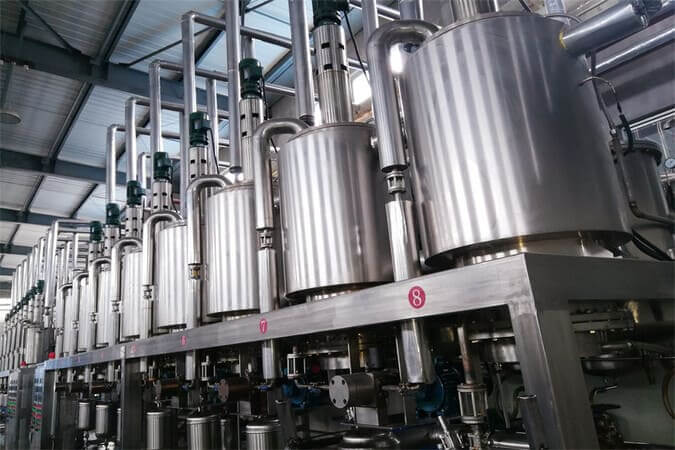
Why Is Molecular Distillation Used in Fish Oil Manufacturing?
Crude fish oil is a complex mixture. Before it can be used in many finished products, manufacturers may need to improve its purity, stability and concentration.
Molecular distillation can help manufacturers:
- Separate selected oil fractions
- Concentrate Omega-3 fatty acids
- Reduce certain unwanted components
- Improve the purity of the final ingredient
- Process temperature-sensitive materials under controlled conditions
- Produce fish oil with specific customer specifications
The exact process configuration depends on the raw material, target specification and desired EPA/DHA concentration.
How Does Molecular Distillation Work?
The basic principle is relatively straightforward.
Fish oil is introduced into a molecular distillation system and spread into a thin film over a heated surface. The system operates under high vacuum, significantly reducing the pressure around the oil.
The process generally involves several important steps:
1. Feed Preparation
Before molecular distillation, the fish oil is prepared according to the required manufacturing process.
Depending on the feedstock and specification, preliminary refining steps may include processes such as:
- Degumming
- Neutralisation
- Bleaching
- Filtration
- Deodorisation
Proper feed preparation helps improve the efficiency of subsequent purification stages.
2. High-Vacuum Operation
The molecular distillation system operates under a high vacuum.
Reducing pressure allows volatile components to evaporate at lower temperatures than would be required at atmospheric pressure.
This is particularly useful when processing sensitive lipid materials.
3. Thin-Film Formation
The oil is distributed as a thin film across the heated surface.
The thin film provides a large surface area and shortens the distance that molecules need to travel during evaporation.
4. Separation
Different components have different volatility characteristics.
Under controlled temperature and vacuum conditions, selected components evaporate and travel toward a condenser, where they are collected as a separate fraction.
The less volatile fraction remains behind.
By controlling the operating conditions, manufacturers can obtain fractions with different compositions.
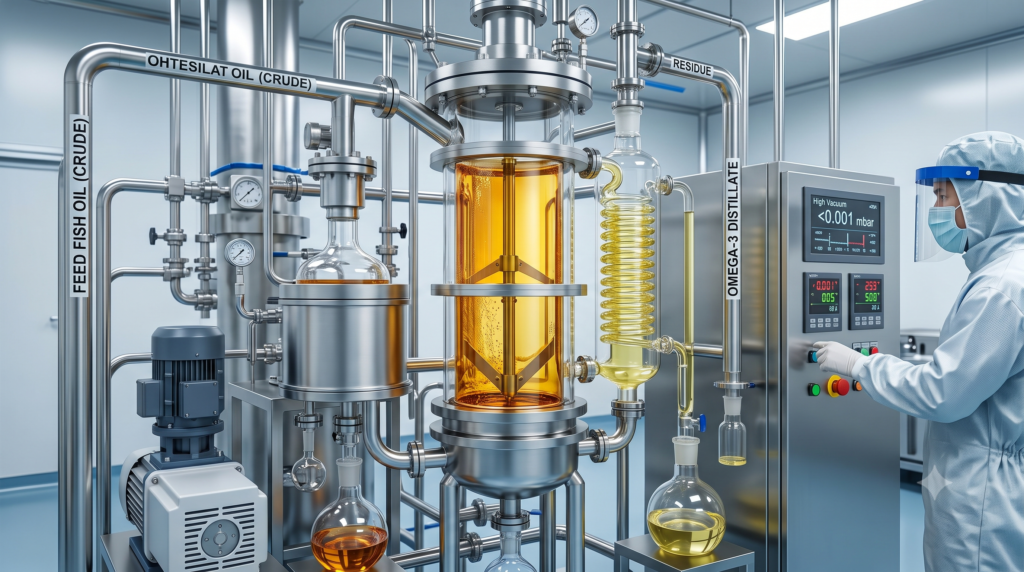
How Molecular Distillation Helps Purify Omega-3
One of the important applications of molecular distillation is the concentration and purification of Omega-3-rich fractions.
EPA and DHA are long-chain polyunsaturated fatty acids found naturally in marine oils. Depending on the starting material and manufacturing route, molecular distillation can be incorporated into a process designed to increase the proportion of targeted Omega-3 fatty acids.
This allows manufacturers to develop fish oil ingredients according to specific customer requirements.
For example, different customers may require different concentrations of:
- EPA
- DHA
- Total Omega-3
- EPA + DHA
The final specification depends on the intended application and product formulation.
Molecular Distillation and Ethyl Ester Fish Oil
Molecular distillation is commonly associated with the processing of Omega-3 ethyl ester (EE) concentrates.
In an EE process, fatty acids are converted into ethyl esters before concentration. The resulting material can then undergo controlled distillation steps to separate fractions based on their physical properties.
This can allow manufacturers to produce different Omega-3 concentrate specifications.
However, molecular distillation is not simply a single step that automatically produces a particular EPA or DHA concentration. The final composition depends on factors such as:
- Starting raw material
- Pretreatment
- Chemical form
- Distillation conditions
- Number of processing stages
- Target specification
Careful process control is therefore essential.
Quality Control After Molecular Distillation
Purification and concentration are only part of fish oil manufacturing.
After processing, the finished material must undergo appropriate quality testing to verify that it meets the required specification.
Common tests may include:
EPA and DHA Analysis
Testing determines the concentration of EPA and DHA and helps verify the required Omega-3 profile.
Acid Value (AV)
Acid Value provides information about the amount of free fatty acids present in the oil.
Peroxide Value (PV)
Peroxide Value is used to assess primary oxidation products.
Anisidine Value (AnV)
Anisidine Value helps assess secondary oxidation products.
TOTOX
TOTOX combines primary and secondary oxidation measurements to provide an overall indication of oxidation status.
Contaminant Testing
Depending on the intended application and applicable requirements, testing may include contaminants such as:
- Heavy metals
- Dioxins
- PCBs
- Other relevant environmental contaminants
These tests help manufacturers maintain consistent quality and meet customer specifications.Molecular Distillation vs Conventional Fish Oil Refining
Conventional refining and molecular distillation serve different purposes and may be used together rather than treated as competing technologies.
Traditional refining processes are commonly used to remove or reduce impurities and improve the overall quality of crude fish oil.
Molecular distillation provides a specialised separation capability that can be used for fractionation and concentration.
A modern fish oil manufacturing process may therefore combine several technologies to achieve the desired final specification.
The exact manufacturing process depends on the quality of the crude oil, target EPA/DHA concentration and final application.
Factors That Affect Molecular Distillation
Several factors influence the performance of molecular distillation.
Temperature
Temperature must be carefully controlled to achieve the desired separation while managing thermal exposure.
Vacuum Level
Operating pressure affects the volatility and evaporation behaviour of different components.
Feed Rate
The rate at which oil enters the system can affect residence time and separation efficiency.
Film Thickness
A controlled thin film helps facilitate efficient molecular transfer.
Feed Composition
Different crude oils have different compositions, which can influence the required processing conditions.
For this reason, experienced process control and laboratory testing are essential for producing consistent results.
Applications of Purified Omega-3 Fish Oil
Purified and concentrated Omega-3 fish oil can be used as an ingredient in a variety of applications, including:
- Nutraceutical products
- Dietary supplements
- Pharmaceutical formulations
- Functional foods
- Nutrition products
- Softgel capsules
- Other Omega-3 formulations
Bulk manufacturers work with customers to provide ingredients that meet their specific technical and quality requirements.
Choosing a Fish Oil Manufacturer With Advanced Purification Capabilities
For companies purchasing fish oil in bulk, manufacturing technology is an important consideration.
A reliable supplier should be able to demonstrate appropriate control over:
- Raw material sourcing
- Purification
- Omega-3 concentration
- Oxidation control
- Laboratory testing
- Batch consistency
- Storage and handling
- Traceability
It is also important for buyers to understand the certificate of analysis (COA) and technical specifications provided for each batch.
A manufacturer with appropriate purification technology and strong quality control systems can provide greater confidence in the consistency of the supplied ingredient.
Why Molecular Distillation Matters for Omega-3 Manufacturing
The growing demand for concentrated EPA and DHA has increased the importance of advanced fish oil processing technologies.
Molecular distillation provides manufacturers with a controlled method for separating and concentrating components in marine oils. When combined with appropriate refining, purification and laboratory testing, it can contribute to the production of high-quality Omega-3 ingredients.
The technology itself is only one part of the manufacturing process. Raw material quality, process control, oxidation management and final product testing all play an important role in achieving consistent results.
Why Choose Nutragen Bio Actives?
At Nutragen Bio Actives, we focus on producing quality Omega-3 fish oil ingredients for customers across the nutraceutical and pharmaceutical industries.
Our approach combines careful raw material selection, controlled processing, purification technologies and quality testing to help deliver consistent fish oil ingredients according to customer requirements.
We work with customers looking for reliable bulk fish oil and Omega-3 manufacturing solutions, with attention to product specifications, quality and consistency.
Frequently Asked Questions
What is molecular distillation in fish oil manufacturing?
Molecular distillation is a high-vacuum separation process used to separate and concentrate components of fish oil under controlled temperature conditions.
Why is molecular distillation used for Omega-3?
It can be used to concentrate and purify Omega-3-rich fractions, including EPA and DHA, depending on the starting material and manufacturing process.
Is molecular distillation the same as fish oil refining?
No. Molecular distillation is a specialised separation process. Fish oil manufacturing may use several refining and purification technologies, with molecular distillation serving a specific role in fractionation or concentration.
Can molecular distillation increase EPA and DHA concentration?
Yes, molecular distillation can be incorporated into processes designed to concentrate EPA and DHA. The achievable concentration depends on the starting material, chemical form, process configuration and target specification.
Why is high vacuum used?
High vacuum reduces the boiling temperature of components, allowing separation under lower-temperature conditions than conventional atmospheric distillation.
Conclusion
Molecular distillation is an important technology in modern fish oil manufacturing and Omega-3 concentration. By operating under high vacuum and controlled temperature conditions, manufacturers can separate selected fractions and produce fish oil ingredients with targeted EPA and DHA concentrations.
However, producing high-quality Omega-3 fish oil requires more than molecular distillation alone. Responsible raw material sourcing, effective purification, careful process control, oxidation management and comprehensive laboratory testing all contribute to consistent final-product quality.
For nutraceutical and pharmaceutical companies sourcing fish oil in bulk, understanding these manufacturing technologies can help them make better-informed decisions when selecting an Omega-3 ingredient supplier.
🔗 Internal links for your website
Add these links naturally within the article:
Fish Oil Manufacturer in Indiahttps://nutragenbioactives.com/fish-oil-manufacturer-in-india/
How Fish Oil is Purifiedhttps://nutragenbioactives.com/how-fish-oil-is-purified-omega-3-manufacturing-process/
Fish Oil Quality Testing: AV, PV & TOTOX Explainedhttps://nutragenbioactives.com/fish-oil-quality-testing-av-pv-totox-explained/
Responsible Sourcing of Raw Materialshttps://nutragenbioactives.com/responsible-sourcing-of-raw-materials/
Sustainable Fish Oil Manufacturinghttps://nutragenbioactives.com/sustainable-fish-oil-manufacturing-balancing-quality-innovation-and-marine-responsibility/
How to Choose a Fish Oil Manufacturer in Indiahttps://nutragenbioactives.com/how-to-choose-a-fish-oil-manufacturer-in-india/