
Cod Liver Oil Market Outlook 2026–2036: Growth Trends, Demand Drivers and Opportunities for Omega-3 Manufacturers
The global cod liver oil market is projected to grow from USD 1.61 billion in 2026 to USD 2.74 billion by 2036, reflecting a compound annual growth rate (CAGR) of 5.5%, according to FACT.MR.
The global marine oil industry continues to evolve as consumers seek nutritional supplements, manufacturers focus on product quality, and brands compete to deliver reliable ingredients. Cod liver oil remains an established product in this landscape because it naturally contains omega-3 fatty acids, including EPA and DHA, as well as vitamins A and D.

According to the FACT.MR Cod Liver Oil Market report, the market is expected to experience steady growth over the next decade. These projections highlight the importance of understanding consumer preferences, sourcing practices, quality management, and the changing requirements of the nutritional ingredient industry.
Global Cod Liver Oil Market Size and Forecast
FACT.MR reports the following market estimates and projections:
| Year | Market value |
|---|---|
| 2025 | USD 1.53 billion |
| 2026 | USD 1.61 billion |
| 2036 | USD 2.74 billion |
| CAGR, 2026–2036 | 5.5% |
The projected increase represents an estimated USD 1.13 billion in additional market value between 2026 and 2036.
These figures indicate a positive outlook for cod liver oil products. However, actual market performance will depend on consumer demand, raw material availability, production costs, regulatory requirements, and competition among suppliers.
Key Factors Driving Market Growth
1. Growing Interest in Omega-3 Nutrition
EPA and DHA are important omega-3 fatty acids used in nutritional products. Consumer interest in omega-3 supplementation continues to support demand for marine oil ingredients.
Cod liver oil offers a distinctive combination of EPA, DHA, and naturally occurring vitamins A and D. This composition differentiates it from many conventional fish oils and influences how finished-product manufacturers position their formulations.
2. Demand for Convenient Supplement Formats
Cod liver oil is available in liquid and capsule formats. Liquid products allow flexible serving sizes, while capsules offer convenience for consumers who prefer a measured serving without the taste of oil.
FACT.MR identifies liquid products as the leading individual product format, accounting for 35.2% of the market in 2026.
Manufacturers can respond to these preferences by focusing on consistent ingredient quality and the technical requirements of the intended finished product.
3. Greater Attention to Product Quality and Transparency
Consumers and supplement brands increasingly need clear information about ingredient identity, composition, purity, and origin.
For ingredient suppliers, reliable documentation and appropriate quality-control procedures help support customer confidence. Depending on the product and its intended use, relevant testing may include fatty acid composition, oxidation indicators, contaminants, and other agreed specifications.
4. Established Demand for Nutritional Supplements
According to FACT.MR, dietary supplements account for 52.4% of the cod liver oil market in 2026, making them the leading application segment.
This highlights the importance of ingredient consistency for businesses supplying manufacturers of finished nutritional products.
Market Segmentation: Important Figures
FACT.MR identifies the following leading segments for 2026:
| Market category | Leading segment | Reported share |
|---|---|---|
| Product type | Liquid | 35.2% |
| Application | Dietary supplements | 52.4% |
| Sales channel | Supermarkets and hypermarkets | 38.9% |
| Source | Wild-caught | 70.7% |
These percentages represent the individual leading segments within their respective categories. They should not be added together because they measure different aspects of the market.
Wild-caught sourcing remains the leading source category in the report. This makes raw material availability, traceability, and responsible sourcing important considerations for companies operating in the marine oil supply chain.
Regional Growth Opportunities
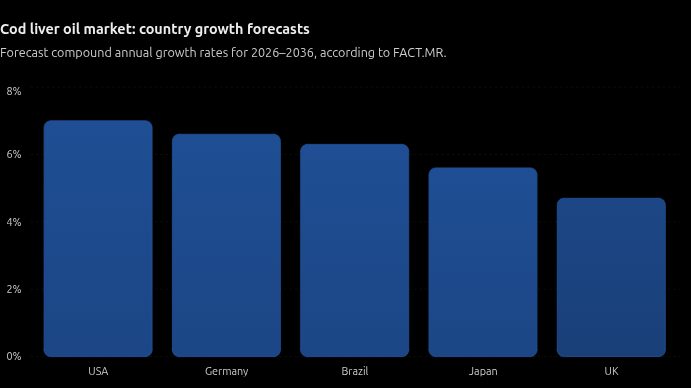
FACT.MR projects different growth rates across selected national markets for 2026–2036.
| Country | Forecast CAGR |
|---|---|
| United States | 7.0% |
| Germany | 6.6% |
| Brazil | 6.3% |
| Japan | 5.6% |
| United Kingdom | 4.7% |
The United States has the highest projected growth rate among these five countries, followed by Germany and Brazil.
These forecasts can help businesses evaluate potential market opportunities. However, country-level growth projections do not automatically indicate demand for a particular bulk ingredient grade or establish the commercial attractiveness of a specific market.
For manufacturers and exporters, evaluating actual customer requirements, applicable regulations, product specifications, and supply-chain costs remains essential.
Challenges Facing the Cod Liver Oil Industry
Despite the positive market outlook, the industry faces several challenges.
Raw material availability: Marine oil production depends on access to suitable raw materials, fishing conditions, and supply-chain continuity.
Oxidation control: Marine oils can be susceptible to oxidation during processing, storage, and transportation. Appropriate handling, packaging, and monitoring are important for maintaining product quality.
Quality and regulatory requirements: Manufacturers must meet the specifications and legal requirements applicable to their products and destination markets.
Cost management: Raw materials, refining, analytical testing, packaging, and logistics can affect overall production costs and commercial competitiveness.
Consumer expectations: Brands must balance convenience, product characteristics, transparency, and price while maintaining appropriate quality standards.
Addressing these challenges requires coordination among raw material suppliers, processors, ingredient manufacturers, and finished-product brands.
What the Market Outlook Means for Omega-3 Ingredient Manufacturers
The projected expansion of the cod liver oil market provides useful context for businesses involved in marine oils and omega-3 ingredients.
For ingredient manufacturers, several priorities remain important:
- Maintaining consistent product specifications and batch-to-batch quality.
- Providing appropriate analytical documentation and traceability.
- Managing oxidation through suitable processing, storage, and packaging practices.
- Understanding the differences between cod liver oil and other marine oil ingredients.
- Building dependable supply relationships with finished-product manufacturers.
It is also important to distinguish the cod liver oil market from the broader fish oil market. Cod liver oil is extracted from cod livers, while other fish oils can originate from different species and tissues. Their composition, applications, and commercial specifications may differ.
Conclusion
The FACT.MR forecast points to continued growth in the global cod liver oil market, with an estimated value of USD 2.74 billion by 2036 and a projected CAGR of 5.5% from 2026 to 2036.
Demand for nutritional supplements, consumer preferences for convenient formats, and attention to ingredient quality are among the factors shaping the market.
For businesses across the marine oil industry, long-term competitiveness will depend not only on market growth but also on product quality, supply reliability, traceability, and the ability to meet customers’ technical requirements.
About Nutragen Bio Actives
Nutragen Bio Actives operates in the marine oil ingredient sector, supplying fish oil ingredients for business customers. Companies looking for marine oil ingredients can contact our team to discuss their application requirements and product specifications.
Visit: https://nutragenbioactives.com/
Market statistics and forecasts cited in this article are attributed to FACT.MR’s Cod Liver Oil Market report, updated 15 October 2026. Forecasts are estimates and may change as market conditions evolve.